There is a thing we do in our household, a sacred tradition that centers around renewing our gay cards. Whenever the need arises, Rio and I scour all our streaming services and visit dodgy websites armed only with our ad-blockers to get our hands on WLW content (women loving women, yes, but also women losing women – we’re not picky, but that’s for later). Our work schedules do not match, so the gay card renewal starts as an individual process. I watch whatever I find on late nights before heading to bed while Rio watches during the small pockets of time in the morning when she’s finally off work. If we stumble upon something we think the other would also enjoy, you can expect us to spend our weekends parked on our couch to watch it together.
Suffice it to say that years’ worth of gay card renewals have led us to a smorgasbord of WLW content, enough to make specific recommendations. Are you in the mood for a good cry but you also want it to be set somewhere picturesque but not touristy? Try out You Can Live Forever and see a girl lose a girl in pretty Saguenay. Do you want a depressing period drama where no one gets what they want and, for extra tears, involves child death and a possible murder? The World to Come may hit the spot. How about something French that’s not Blue Is The Warmest Color or Portrait of a Lady on Fire? Consider Summertime (featuring feminists loving feminists in rapid fire French). Cate Blanchett and Rooney Mara were great in Carol, but let me introduce you to My Summer of Love (young Emily Blunt’s contribution to the WLW genre) and Distance (featuring Iza Calzado). Up for a rom-com fest? Start with Crush (for the high school setting), then Imagine Me And You (the bride falling for her florist sounds problematic but it turns out cute), and end it with an Alice Wu double feature (watch Saving Face first before The Half of It).
If you have a general working idea of the composition of our household (two gay girls – together for 15 years and married for two with two dogs), you’d wonder why there is a need for us to watch more gay content when our everyday life is essentially gay content. I can’t speak for Rio, but I do it because it’s normalizing – akin to going to Pride minus the crowds, which is perfect for an introvert x couch potato like me. So while some people drape the rainbow flag around their backs and march, I turn on the TV and watch.
Being Picky was Not an Option
It doesn’t take a lot for a certain piece of content to make it to our gay card renewal ritual. We’ll give a film, a TV show, a documentary, and everything else in between the time of day for as long as it has girls pining for each other. The girls don’t even have to be the main characters. They don’t even have to kiss (though that’s always welcome) or have steamy scenes (apparently, kids call it boombayah nowadays?). Being endgame isn’t even a requirement (we watched Kissing Jessica Stein to the very end and continued watching Orphan Black even after Delphine Cormier got shot). We are not picky. Why? Because as older millennials, being picky about your content was not an option when you’re at the mercy of free TV.
My age will show, but my first taste of continuously accessible LGBTQ+ representation in media came courtesy of Dawson’s Creek (thank you, Studio 23). To this day, I still remember Jack McPhee’s coming out scene, the way he broke down in sobs on the stairs while his father and sister helplessly watched. Why? Because the thought that crossed my 14-year-old mind then was “that could happen to me” (and you know what, it kinda did many years later). Rio points to Xena: Warrior Princess (thank you, Channel 5) as the closest thing she had to accessible WLW content growing up, never mind if the showrunners were queerbaiting 90% of the time. Back then, it wasn’t frowned upon for a gay character to be injected in any given show for comic relief, to temporarily drive up ratings during sweeps season, or for no reason at all but to sexualize a particular character. Forget about giving these characters elaborate story arcs or proper exits, their purpose was to be outliers – there to represent behavior that’s different from the norm. It’s not their backstories that mattered, it’s the shock factor they brought that counted. And in the rare case when a gay character was given some semblance of character development or a storyline that spanned seasons and not episodes, they either got buried or put on a bus.
As options beyond free TV thankfully became available, I learned that there were outliers among the outliers. I was 19 and studying for my finals when I chanced upon Saving Face on basic cable. Although it was a heavily censored, read-between-the-lines version (quite the overkill considering that it was shown at 2 a.m.), it was clear to me that while being a lesbian was still an issue, love and acceptance could still win in the end (and you know what, this also thankfully happened for me). Around the same time, a local cable channel was also showing MTRCB-approved episodes of The L Word, which led me to get my hands on bootleg DVDs just so I could get the complete problematic picture. Toxic or not (they can never make me hate you, Jennifer Schecter), the general idea of a found family where being gay wasn’t the biggest issue appealed to me. Why? Mainly because I spent most of my very early 20s vacillating between pining for the could-be gay or asking myself if I was really gay in the first place.
During those days of wanting to fill a then-unnameable void, the least complicated option to counter that particular loneliness was going to AfterEllen.com (RIP). I used their recommendations as a compass to sail the pirate seas for more WLW content. It led me to travel back in time (Desert Hearts, The Children’s Hour) or know more about conversion therapy (But I’m a Cheerleader, The Miseducation of Cameron Post – the book, not the film but the film is also nice). Most of the time though, the films in their listicles (I Can’t Think Straight, Personal Best, D.E.B.S, Lost and Delirious, The Hunger, The Incredible Adventures of Two Girls In Love, Show Me Love, among many others) simply made me feel less alone. I still rewatch some of them when I have the time as a way to remember that like my WLW options, I too have come so far.
Tell Me You Know Nothing About Lesbians Without Telling Me You Know Nothing About Lesbians
We may not be picky about what makes it to our gay card renewal ritual, but we are discerning – especially now that there are more options available on YouTube and streaming services. While we tend to be more forgiving of films and short films (we usually just finish watching them even if they’re bad because the agony would end soon anyway), we cannot say the same thing about TV series. They require more time and emotional investment, and really, life is too short to be spending time watching a bad TV show that doesn’t give you any kind of joy. Usually, we’ll need a few episodes to gauge whether or not a particular series makes it to the weekend watch schedule. But there have been rare cases where we instantly know it’s not for us.
One such TV show emerged when Rio was renewing her gay card last July 2024. Netflix had been aggressively pushing for us to give this series a shot, probably because we’ve watched The Half of It and Happiest Season too many times. “Ooh, it’s from Thailand!” Rio excitedly told me over chat while I was at work. “I’m checking it out now. I’ll let you know if it’s good.”
About 15 minutes later, she sent me another message – one that made me snicker but also curious.
“It’s bad…Think Grey’s Anatomy but produced and written by Channel 7. And the women in this show obviously don’t know how to touch another woman. Hindi ba kayo nag-workshop? Wala man lang bang research involved?”
Naturally, I immediately wanted to see for myself. I got home to Rio waiting for me on the couch, sipping her first cup of coffee and dreading having to rewatch the first episode of the bad TV show for the second time on the same day. I believe she used a Friends analogy as she begrudgingly pressed play. “So this is what Chandler must have felt when he watched Candy and Cookie again.”
It didn’t take long for me to know what she meant. Because 30 minutes in, I realized that the main subtext of this GL series could very well have been “tell me you know nothing about lesbians without telling me you know nothing about lesbians.” I spent the entire hour furrowing my brows (because the acting wasn’t so hot either) and screaming “Hell no! I am not coming anywhere near those long manicured nails-slash-talons!”
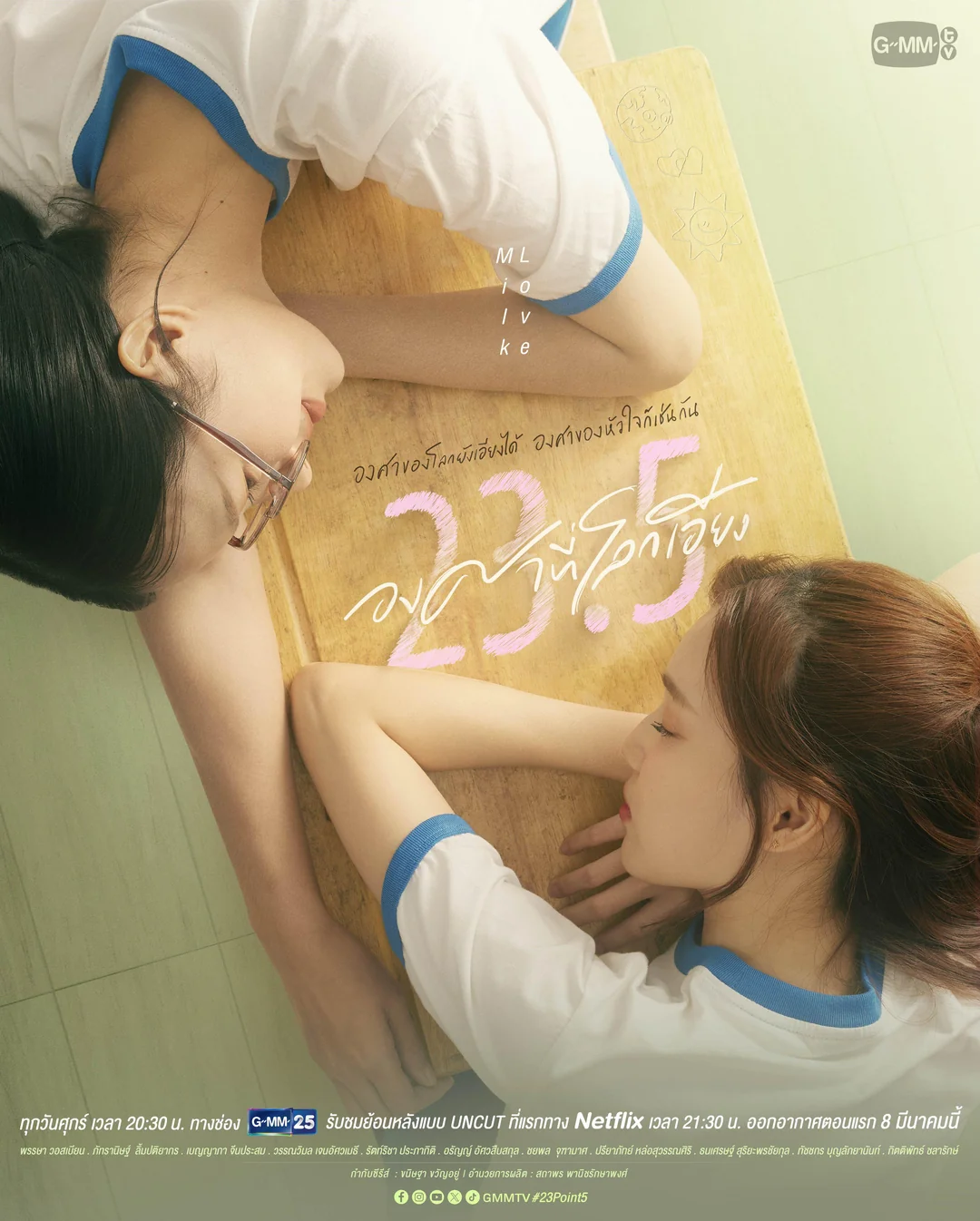
It would be fun to name drop and poke fun at this Thai GL series some more – but I won’t. Because I have this nope-not-for-us show to thank for leading Rio and me to 23.5 – or what is perhaps the best thing I watched in 2024 (and yes, I would die on that hill).
But It’s Set in High School and I am Old
23.5, GMMTV’s first foray into Girls Love or GL, is the story of Ongsa (Milk Pansa Vosbein): a shy 10th grader, fresh out of Phuket and adjusting to life in Bangkok. On the first day of her fresh start, Ongsa meets Sun (Love Pattranite Limpatiyakorn): one of the most popular girls in school and someone whom Ongsa has been following on Instagram even before they became classmates (Ongsa goes by the pseudonym “Earth” and uses an ambiguous photo of her shadow as a profile pic on her finsta). Proximity breeds curiosity, and Ongsa as Earth begins awkwardly reaching out to Sun. Eventually, their online relationship blossoms from the harmless good night-good morning to something more playful, more caring, and more romantic. There’s just one problem – Sun has assumed that Earth/Ongsa is a teenage boy, and unable to resist the one chance she believes she has at being in Sun’s orbit, Ongsa plays along.
On paper, the only thing about 23.5 that screams made for middle-aged lesbians are the pretty lead actresses. Everything else about it will initially make you say not my thing. For starters, it is set in high school – a time and mindset that is so yesterday for us (the lead actresses were toddlers when Rio and I graduated from high school). Then there’s the whole mistaken identity plot device – which gives off a nothing new feel to it and creates the impression that 12 episodes seem excessive for dealing with something so simple and juvenile. The overall wholesomeness from 23.5’s official trailer alone might be enough to put off those in search of something spicier, or those who are not new to Thai GLs and have a set of expectations coming into this series.
But fresh from the disappointment of a show that seemed to tick all our boxes, Rio decided to take a chance on 23.5 (it was already available in full on Netflix for months, yet for some reason, we weren’t getting it on our recommendations). “At the very least, it’s Y.A.,” Rio said to me over chat as she started Episode 1 with little to no expectations. When I didn’t hear from her again after an hour, I assumed it was boring and she fell asleep on the couch. And just as it was about to become an afterthought, Rio sent word.
“Oh that was cute. That was really cute. We should watch it together.”
I’d like to say that it was love at first watch for me, but I treated 23.5’s first episode as pleasant background noise that I glanced at every once in a while. The show’s theme song, I have to admit, was catchy even if I had no idea what it meant. In my head though, it was still a high school story – and Y.A. has always been more of Rio’s thing. But Episode 2 rolled along, and I found myself smiling as I watched Ongsa in her bed – reunited with the phone she lost earlier in the episode – messaging Sun to apologize for a day’s worth of radio silence.
“Did you really lose it though?” Sun’s reply to Ongsa said, “or did you just want me to miss you?”
And then like Ongsa, I – a lesbian in her late thirties whose go-to response in life is to compartmentalize and be stoic – found myself grinning from ear to ear, suddenly having the urge to bounce around in bed. Because like Ongsa, I couldn’t contain the butterflies in my stomach.
That’s when I knew that Rio and I had stumbled upon something special.
The Best Part(s)
There’s a bit from The Half of It where Ellie Chu talks about how her mother believed that every film, every song has a best part. While I am no expert in acting or production to give you a complete technical rundown of 23.5, I genuinely believe that while it’s not perfect, this series is rife with so many best parts.
For starters, it captures what is probably one of the best first kiss scenes I’ve seen in a TV show in a long while. It works not because it’s hot and heavy, but because it is beautifully layered with so many emotions: anticipation (Aren’t you going to make a move?); nerves (I don’t know what I’m doing!); anxiety (I made the first move but she pulled away. Because she was shocked? Or was it because she wasn’t into it?); desire (I liked that. I want more.); and that feeling of finally, finally being able to convey to the one person who matters just how much you want them (God, I love this girl). As someone who has seen her fair share of first on-screen kisses, enough to be unfazed when it finally happens, Ongsa and Sun’s first kiss still manages to leave me breathless.
Which leads me to the heart and soul of this series: Milk, Love, and their lights-out chemistry.
Rio and I came into 23.5 with no idea about Thai GL, much less the actresses in GL pairs. So imagine our surprise when we found out that Milk, who plays 15-year-old Ongsa, was already in her mid-20s when filming first started. And while that’s a typical trope in teen shows, Milk as Ongsa is so genuine that you forget her real age entirely. Having watched other GMMTV-produced shows after finishing 23.5, I personally believe that no one other than Milk could have portrayed Ongsa with that kind of awkward, earnest sincerity that rarely feels performed or out of place.
It’s a slightly different story for Sun – in the sense that there are probably other GMMTV actresses, aside from Love, who could take on the role and do it well. Even so, it’s hard to imagine anyone else doing quite what Love does with it. Her portrayal is, as expected, sunshine incarnate – radiant and bright. But it’s the smaller details, the way she so easily conveys emotion with just her eyes, that make her version of Sun feel completely genuine.That first kiss I was gushing about? It works mainly because of how Love’s Sun reacts to every push and pull.
When you put the two of them together, it’s fire. Not a conflagration, but the kind that settles in and soothes…like sitting by a fireplace when it’s very cold outside (mushy, I know, but that’s MilkLove’s niche). MilkLove’s chemistry doesn’t just sit on the screen, it spills out of it. It’s in the way they look at each other, the way even the quiet moments feel full and warm instead of empty. Nothing about it feels forced or manufactured – it just works, effortlessly, in a way that makes you believe every bit of it.
The supporting cast also gets a best part nod because almost all of them have a best part in the show. View Benyapa Jeenprasom’s Aylin (Ongsa’s cousin whose hyperfixation revolves around extraterrestrials) is equal parts weird and adorable. Her best part for me is a funny scene in episode 11 where she attempts to walk back an invitation for her girlfriend, Luna (portrayed by June Wanwimol Jaenasavamethee), to sleep over right in front of her aunt and uncle (Ongsa’s parents). For Alpha – Ongsa’s older sister (portrayed by Ciize Rutricha Phapakithi) – it’s the way she busts into Ongsa’s room, kitchen knife in hand, when she hears Ongsa and Sun screaming their lungs out (it’s not what you think). There is a tender scene between Ongsa’s friend, Tinh (Ford Allan Asawasuebsakul) and student council vice president Mawin (Euro Thanaset Suriyapornchaikul) where they talk about how love has an expiration date. Even the teachers, Teacher Nida (Golf Kittipat Chalaragse) and Teacher Bambam (Godji Tachakorn Boonlupyanun), have a small, heartwarming love story that makes me smile.
When a Show Heals Parts of Yourself You Didn’t Even Know Were Broken
There is this scene in 23.5 – I like to call it The Swings Scene. It happens in the last part of Episode 6 – the episode where the other shoe drops. Where Sun finally finds out that Ongsa is Earth. A day after the discovery, a distraught Ongsa runs away from Sun after bumping into her at the local convenience store. Sun, who spends the night sorting out her feelings about Ongsa/Earth, goes after Ongsa and finds her sitting in one of the swings of a neighborhood park.
What follows is the best part of 23.5 for me. A scene that heals parts of myself I didn’t even know were broken in the first place. I’ll leave it here for you to watch.
I remember talking to Rio as I wiped my tears. “I don’t know why that made me cry,” I think is what I told her. “Maybe it’s the background music,” I probably even added to downplay my own reaction. Later that night, with the question still hanging heavy in my head, I rewatched the episode, finally landing on an answer as I cried again.
I realized that I reacted that way to this scene because if this were “real life,” the young gay girl would most likely get a much expected rejection. What would probably come next is losing a friend, because really, how can you be friends after this? Then the questions and speculations from other people – other friends, classmates – would follow. “What happened between you two?” Eventually, the truth would be revealed. The murmurs would get loud and pronounced…and the young gay girl would have to deal not only with the sting of rejection but with the heartbreak of coming to terms with who she really is.
An outlier in a world where being different is not only difficult but largely unrecognized.
Then it sinks in further. Because that perception of “real life” was essentially my worldview 20-plus years ago when I was around Ongsa’s age. If that were me, if I were Ongsa, there wouldn’t even be a swings scene because there wouldn’t even be a confession. It wouldn’t get to that point because I would keep it in, filing the feelings I caught inside tiny boxes in my head. It’s why I became quite good at compartmentalizing at such a young age. At hiding parts of myself.
And perhaps that’s why this scene stays with me the way it does, why I think it’s the show’s best part. Because 23.5 chooses a reality that I couldn’t even imagine can be real when I was 15 – one where the confession doesn’t lead to humiliation or loss, where the other person doesn’t recoil or disappear, but instead stays, listens, and meets that vulnerability with care. It’s quiet, almost understated, but it feels radical in its own way. Not because it’s something I find hard to believe, but because it’s something I get to live every day with Rio. And seeing it reflected back on screen, in all its softness and sincerity, always manages to catch me off guard. The tears I cry whenever I watch this scene are not tears of sadness for 15-year-old me. They are tears of gratitude – for the life I get to live and the woman I get to share it with.
What’s that thing they say? I looked up and suddenly, the world is different? Thank heavens for that.
Not Liking This Show Is a Privilege
A quick Google search or a shallow dive into the relevant Thai GL subreddits will tell you that 23.5 has gotten its fair share of criticisms from fans and casual viewers alike. Most of them are actually valid points and I respect that some people didn’t like it. Heck, I wasn’t even sure if it was for me when I first started watching it.
I do believe, though, that passing up on this series – being able to say that wholesome, high school shows are not my thing – is such a privilege for this generation. It means there’s enough content out there now to choose from, enough stories being told that you can afford to skip one and still find something that feels right for you. And maybe that kind of abundance changes the way we engage with stories like this. We’re no longer watching just to see ourselves reflected – we’re watching with expectations, with preferences, with standards shaped by everything that’s come before. So when something like 23.5 leans into softness, into simplicity, into a kind of sincerity that doesn’t try to be anything else, it’s easy to dismiss it for what it isn’t instead of seeing it for what it is.
Still, there’s value in that kind of storytelling too – especially for the people who are just beginning to see themselves in it. Or for people like me who look back and recognize just how far things have come.
Leave a Reply