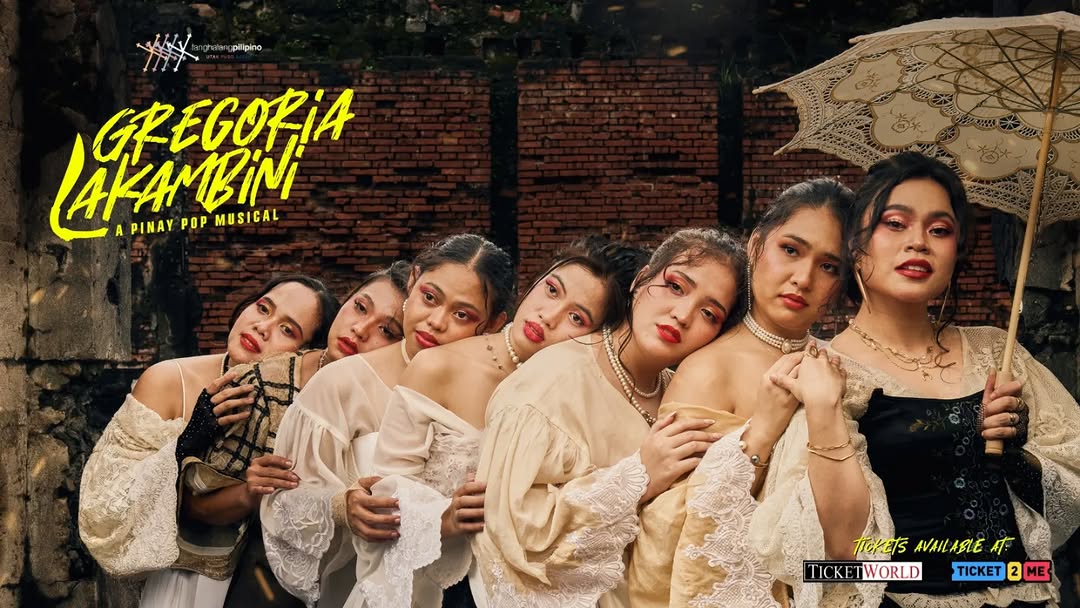
Imagine this: a rainy Saturday, early evening. November. I was behind the wheel, stressing the hell out of my wife. Traffic on Commonwealth, then on Quezon Avenue going to Skyway. When we exited Skyway, our little hatchback was flanked by 18-wheelers on Quirino Avenue, then Roxas Boulevard where a stupid Mitsubishi Adventure cut us off while turning right into Vicente Sotto St to get to Tanghalang Ignacio Gimenez.
All the names mentioned there, ironically, are all male. Quezon, Quirino, and Roxas were presidents. Vicente Sotto was a senator, playwright, and journalist. Ignacio Gimenez is a former President of the Manila Stock Exchange, philanthropist, and patron of the arts with a background in theater.
We were there on a rainy Saturday evening, braving post-sweldo Manila traffic, however, for a woman.
Gregoria de Jesus — Oryang, Lakambini of the Katipunan, wife of Andres Bonifacio, custodian of its most sensitive documents, and by most accounts of history, footnote — gets a musical. A P-pop musical, written by Nicanor Tiongson and Eljay Castro Deldoc, with music by Nica Del Rosario and Matthew Chang, produced by Tanghalang Pilipino.
We ended up watching it twice.
Philippine History, A Heavily-Male Cast, Somehow
The main cast of the Philippine revolution, as taught in school, is aggressively male. Bonifacio. Rizal. Aguinaldo. Luna. Mabini. Jacinto. GomBurZa. Sakay. The women exist in relation to them — as wives, as mothers, as the occasional exceptional case who picked up a weapon when there was no man left to do it. Gabriela Silang is remarkable precisely because she is treated as the exception. The rule, apparently, was to stay home.
Here is what Philippine history class teaches you about the women of the revolution: Gabriela Silang led a revolt after her husband Diego was assassinated and fought for four more months before she was captured and executed. Tandang Sora (Melchora Aquino) sheltered wounded Katipuneros in her home. The women of Kawit sewed the flag. The women of Malolos petitioned for education.
And then, largely, the women stop.
This is not entirely accurate. Women taking up arms, women organizing, women doing the quiet and dangerous work of keeping a revolution alive — none of this was uncommon. It was simply not the version of history that made it into the textbooks, onto the street signs, into the names of the theaters we drive to on rainy Saturday evenings.
What of Teresa Magbanua? Agueda Kahabagan? Nieves Fernandez? Trinidad Tecson? Remedios Paraiso-Gomez?
What of Gregoria de Jesus?
Gregoria de Jesus was the Lakambini of the Katipunan. She kept its documents. She kept its secrets. She was, by any reasonable measure, essential.
Women have stories, too. Sometimes, it doesn’t end with a noose (in Gabriela Silang’s case) or exile to Guam (as in Tandang Sora’s story). Sometimes, it ends in quiet stories of heartbreak, picking up the pieces and sewing yourself back together.
A Story About A Girl: Nah-ah
The play opens with the song Gregoria Lakambini.
Okay, it doesn’t. There’s an overture that features Oryang’s Sampung Tagubilin Sa Mga Kabataan (Ten Instructions/Reminders To The Youth), but we’ll get back to that in a bit.
As soon as the opening lines were sung, I became aware of two things: one, that this musical was made for a very specific demographic of which I am not a part, Gen Z; and two, that this musical is going to live in my head for a very long time.
This is a story about a girl — na-ah. Hindi ‘to fairytale. This is herstory.
And then, before you have time to process that, the ensemble is spelling out G-R-E-G-O-R-I-Aeeey, and Oryang is introducing herself, and the whole thing is already moving faster than traffic on Roxas Boulevard on a rainy Saturday night post-sweldo.
The P-pop framing is not incidental. It is the point. Nica Del Rosario and Matthew Chang wrote a score that is unapologetically modern — bright, propulsive, laced with kulintang, pan flutes, and bandurria and other ethnic instruments that root it somewhere specific even as the sound reaches for something younger and louder. The effect is deliberate: this is not a museum piece. This is not history class. This is Oryang’s story told in a language designed to make sure you don’t look away.
It works.
It is also highly effective when the Koro, the Greek chorus, here is used extremely well.
I was born in Caloocan on the 9th of Mayo
Si tatang nanilbilihan bilang Gobernadorcillo (Dad, served as Gobernadorcillo)
Si nanang, Kabitenya, ‘la masyadong napala (Mom, a Cavitena, didn’t really get much)
Dahil buhay ng babae n’on wala masyadong halaga (Because back then the life of a woman didn’t amount to much)
Talaga? (Really?)
‘Yan ang buhay ng dalaga n’on (That’s the life of a young woman back then)
‘Di ko lang sure… Parang applicable pa rin ngayon (I’m not sure, it sounds applicable even now)
A word about the Koro
If you’ve seen Hercules, you know the one — the Greek chorus as hype women, as narrators, as the part of the audience that got a microphone. Gregoria Lakambini uses this device and uses it well. The Koro does some heavy lifting: exposition, sassy asides, and a very specific brand of Gen Z-speak that is funny precisely because of how aggressively it does not belong in an 1890s revolutionary period piece. And yet it does. Somehow it does.
They’re the ones who deliver the Oryang biographical rap in the opening number. They’re the ones who drop the “parang applicable pa rin ngayon” truth bomb that made me chuckle.
And then in Oriang Wild and Free, they pivot to covering the courtship of Oryang and Andres Bonifacio like it’s a kilig-inducing loveteam moment. Andres, for context, was ten years her senior, an actor, a widower, penniless, and, most importantly, a Mason. The Koro presents all of this with the enthusiasm of a fandom account dropping a new pairing.
Mas exciting talaga ang love story ‘pag strict ang parents. (Love stories are more exciting when the parents are strict.)
The parents, naturally, are not thrilled. Tatang and Inang’s objections are reasonable by any metric: no bienes, no lupa, no house, a man already marked by the law, a Mason in a time when being a Mason meant a date with a noose. Oryang’s response is delivered with the full conviction of someone who has made up her mind and is no longer taking questions.
The Koro frames this as a classic romcom. The incongruence is the joke. The incongruence is also, somehow, not a joke at all — because underneath the Gen Z framing is a woman who has just, at eighteen, decided exactly who she is and what she’s willing to lose for it.
The Koro knows this. They make sure you know it too.
The amazing Koro, by the way, is made up of Anya Evangelista (Koro & Andres Bonifacio), Sarah Monay (Koro, Tatang, De Las Alas), Sofia Sacaguing (Koro & Julio Nakpil), Heart Puyong (Koro & Aguinaldo, against her will), Ynna Rafa (Koro & Juan Nakpil), and Murline Uddin (Koro, Petrona, Bonzon).
The Revolutionary Love Team: As Sung in Buwan, Buwan
But before we get to the revolution, we get to our love team’s duet Buwan, Buwan.
The song, interestingly, starts out as a wish list. Oryang asks the moon for a man who is strong and steady, a liberator, someone who can hold her mind, her heart, and her hands. A man who she can walk beside. Andres asks for a woman who is beautiful, whom he can love and cherish, who’ll be his princess. The Laura to his Florante.
And then they find each other, get married, and the wish changes.
Together, they ask the moon for a sundang (a bolo, or a sword). Not for battle (not yet) but to cut bamboo. To build walls, a floor, a roof. A small home, filled with knowledge and love.
Oh tayo sa dulo at walang hanggan.
It is the kind of love song that disguises itself as a simple thing and then, in the coda, reveals what it actually is. The love they are asking to share, they sing at the end, must also be for the country. Pagmamahal na pagsasaluhan, malaan din para sa bayan. This is the whole point of Oryang and Andres — that the personal and the political were never separate for them, that the home they wanted to build and the nation they wanted to fight for were made of the same materials.
Andres: The Revolutionary Dreamboat
Which brings us to Andres.
Anya Evangelista’s Bonifacio is not what you might expect from a stage portrayal of the Father of the Philippine Revolution. He is not mythologized. He is not made large. He is, instead, exactly what the historical record suggests he was: patriotic, earnest, honest, and broke. A man of deep conviction and very little else in the way of material resources, who believed in something so completely that it never occurred to him to be embarrassed about the rest.
The all-female cast is not a new idea — Japan’s Takarazuka Revue has been doing it for over a century. But for something historical and Filipino, it was new. And what it does here is quietly radical. Stripping away the statues and the streets named after him, putting Bonifacio in the hands of a woman, forces you to see him differently — not as monument but as person. Anya plays him without irony, without winking at the audience about the casting choice. She finds and delivers the naivete, the earnestness, the specific dignity of a man who clung to his Masonic ideals of brotherhood and loyalty even as his detractors had so obviously thrown the rulebook out the window.
It is, as it turns out, a very effective way to make you root for him.
Marynor Madamesila’s Oryang
Marynor Madamesila’s Oryang shines the brightest in the darkest parts of the woman’s history.
And the show does not spare her. Gregoria Lakambini is, at its core, a trauma conga line. The revolution is outed, Andres and Oryang are relentlessly pursued. Their infant son dies of smallpox. Her father and brothers are arrested and executed. During the violent confrontation of Andres’ arrest — in which his brother is shot and killed — Oryang is violated. The Koro handles this the only way it can: with disgust, with outrage, with the fury of witnesses who cannot intervene.
And then Andres is shot, stabbed, detained, and executed in the mountains of Maragondon.
Oryang spends four weeks looking for his body.
There is a Pananaghoy — Oryang surrounded by the Koro, weeping and wailing, held and witnessed by the women around her. Marynor breaks you here. And then, later, she breaks you again.
The reprise of Buwan, Buwan is not a love song anymore. It is a search. Oryang, alone, asks the moon to show her the way back to him. Asks the rain to fall so she can find their bodies in the bloodied ground. The Koro narrates around her in fragments: four weeks combing the mountains. Days and nights searching every corner and thicket. Stomach empty, throat dry. A dress hardened with mud.
And then, at the end, she sings his part too.
Magmahalan, tayo sa walang hanggan. Ikaw ako, walang dulo.
The duet becomes a solo. The wish they made together — the home, the sword, the love for the country — sung now by only one voice, to no one, in a mountain where his body lies.
It’s important to note here that Andres (with his brother, Procopio) were executed on the 10th of May, 1897. The day before had been Oryang’s 22nd birthday.
And then, after the searching, after the wailing, after the Koro’s outrage has quieted — there is Paalam, Andres.
Magmula, giliw, nang ikaw ay pumanaw
This is the kind of grief that is both hopeless and helpless. It’s not the fresh, violent kind — the kind that has moved into the body and made itself at home.
For me, here is where it loops back to the Gregoria Lakambini song, sa mundo ng mga lalake, pinanganak ako para tumahimik. (In a world of men, I was born to stay quiet.)
To whom was she going to turn? Their fellow revolutionaries, the same ones her late husband had trusted and had later betrayed him? The (Guardia Civil) Veterana, who were still hunting down revolutionaries?
The heart, she sings, that is thoroughly suffering.
And at the center of it, like a splinter: his last instruction. Magtiis ka, sinta. (Endure, my love.) The sweetness and the cruelty of it — that the man she is grieving left her with an order to survive the grieving.
Paalam sa iyo, masarap magmahal.(Goodbye to you, who loved so well.)
Marynor carries all of this without ornament. The song does not ask to be performed — it asks to be inhabited. And she does.
Also, an extra twist of the knife: Gregoria de Jesus herself wrote the Magmula, Giliw, Nang Ika’y Pumanaw poem from which the song was based.
Now What?
But Gregoria Lakambini is not only a story of loss. It is also, quietly, a story of what comes after.
Julio Nakpil — one of Bonifacio’s generals, a composer who wrote a national anthem for a revolutionary leader who did not live to need one — takes care of Oryang after Andres’ death. He proposes. And in Bagong Pag-ibig, he makes his case with the gentleness of a man who understands exactly what he is asking. He may not fully appreciate the enormity of her heartbreak, something that he admits, but is asking still.
Oryang’s answer is not a swooning yes. It is a warning.
Sigurado ka ba? Mabigat ang aking dala. (Are you sure? What I carry is heavy.)
This is, after all, a woman who has survived an enormous amount of crap over a four-year period. Nakpil, cleverly, is not framed as a replacement, but a continuation. A different chapter, someone who looked at everything she was carrying and said: I know. Hand it here.
And then Emilio Aguinaldo comes for dinner.
Oryang’s sister-in-law Petrona is hosting the general — by this point running for president — and Oryang, who has not forgotten a single thing Aguinaldo did to her and her first husband, serves him a song. Bon Appetit, Heneral is a diss track. It is deliciously petty, historically earned, and — in a show that has made deliberate use of food as metaphor — entirely on brand. Lutong Makaw, the show’s earlier number about the Tejeros Convention, already established the pattern: Aguinaldo’s crimes, served on a plate. Bon Appetit is the dessert course. Dinuguan on a white suit.
It did not lose the fury nor the comedy on the second watch.
We watched it a second time with Remi’s parents. The experience was, to put it mildly, different. The P-pop framing that had me chuckling at the incongruence required, for them, a real-time translation — not of the Filipino, but of the Gen Z. The Koro’s asides that landed immediately for us (two Elder Millennials) needed footnotes. We were, essentially, providing simultaneous interpretation between two generations across an 1890s revolutionary musical.
I found this funny. I also found it fitting.
Because this is what Oryang left behind, among other things: her Sampung Tagubilin sa mga Kabataan. Ten instructions to the youth. The overture we heard at the very beginning of the show, before Gregoria Lakambini even started, before the G-R-E-G-O-R-I-Aeeey rap and the Koro’s hype energy and before we all fell in love with Anya Evangelista’s earnest, “masarap magmahal” Andres. Before all of it, there were these ten reminders, written by a woman who had survived everything the show had just put us through.
Number 8: Matakot sa kasaysayan pagka’t walang lihim na di nahahayag. Be afraid of history, for there is no secret that is not eventually revealed.
Gregoria de Jesus kept the Katipunan’s secrets. She kept her grief. She kept going. And for a very long time, she was a footnote. On the street names, in the textbooks, in the names of the theaters we drive to on rainy Saturday evenings in November. Meanwhile, the men remain front and center.
Gregoria Lakambini is a show that is very loud about its message, I can still hear Saya’t Alampay‘s chanting chorus “Laban ng kababaihan ay laban ng Lakambini” and you know what, I wish more people would hear it.
Gregoria Lamkambini: A Pinoy Pop Musical enjoyed a much needed, albeit brief run at the Hyundai Theater in Arete Ateneo.
Some of the songs are available on Spotify.
Listen to Gregoria Lakambini songs on Nica del Rosario’s YouTube Channel. (While you’re there, listen to Tahanan, too.)
Check out Tanghalang Pilipino for more plays and shows like this.
Leave a Reply